
“It’s a great professional development opportunity,” they said. “We need younger people and a fresh perspective.” “It’ll look good on your résumé.” And just like that, I was coerced into joining my first nonprofit board at the tender age of 24, a fledgling lawyer in my first year out of law school. Of course I said yes. What young associate in #BigLaw says no to a senior partner who supervises them? Besides, the concept of boundaries was about as foreign to me as Robert’s Rules of Order.
What followed was a year of confusion. Here are just some questions I asked myself but was too afraid to voice to my peers.

the author’s puppy confused about his role in the household; clearly he is the boss
Am I here to provide pro bono legal services?
Do I get a voice in how the executive director manages staff even though I’m not an HR expert?
If I don’t like the organization’s core value of “excellence” (because it’s too obvious; who wouldn’t want to be excellent?), can I demand we revisit the organization’s values?
If I become a board leader, does that mean I become the boss of the executive director?
But I realized that it wasn’t just the newbie who was confused. Our Board Chair was a seasoned veteran who had helped launch the organization 20 years earlier, and had since taken a “back seat.” (Which in practice meant serving as Chair for seven years because term limits were as foreign to this board as boundaries were to me.) In his presence, the Executive Director cowered. Frankly, so did I. The Chair expected us to approve everything, from the annual budget (makes sense) to auction items for the gala (why exactly?) to the exact wording of the gender-neutral bathroom sign in the office (not our lane!). He seemed to think he was in charge. He was not.
The Root of the Problem: Blurry Lines
If any of this sounds familiar, you’re not alone. One of the most persistent challenges in nonprofit governance is confusion about the respective roles of boards and staff. And when the lines blur, things tend to go sideways in one of two directions. In one direction is micromanagement, where boards insert themselves into day-to-day decisions, undermining staff authority and effectiveness. In the other direction is rubber-stamping, whereboards disengage entirely, approving whatever is put in front of them without meaningful oversight. One stifles organizations; the other puts them at risk.
Here’s the tricky part: this confusion often comes from a good place. Board members are typically accomplished, thoughtful people. Many bring deep expertise, often in the organization’s core program areas. Naturally, they want to be helpful. They offer ideas, suggestions, and sometimes strong opinions. But when those suggestions start turning into directives, boards cross into dangerous territory.
Conservation Capacity Project Webinar – May 21 at 10-11am PT
How We Stay in the Conservation Movement: A Conversation About Grace – a panel conversation with Kristi Chester Vance, David Lamfrom, and Ronda Lee Chapman
Through conversation, self-reflection, and interactive exercises, we’ll focus on bringing humanity into leadership, creating permission for leaders to acknowledge struggles and burnout. Our goal is that you leave with a trail map to the joy and grace you deserve, a good laugh in your belly, a campfire of validation, and a strong tailwind as you carry forward.
The Conservation Capacity Project is cohosting this conversation with TREC to strengthen our community.
Why Overreach Matters
When boards drift into staff roles, a few things tend to happen:
- Staff are disempowered. It becomes unclear who is actually responsible for decisions.
- Innovation suffers. Staff are less likely to take risks or try new approaches if they’re being second-guessed at every turn.
- Accountability blurs. If the board is making operational decisions, it becomes much harder to hold the Executive Director accountable for results.
And perhaps most importantly: board members are rarely as close to the work as staff are. What looks like an obvious solution from the boardroom may not hold up on the ground.
…And Why Disengagement Isn’t Any Better
On the flip side, staff don’t always have perfect perspective either. They can be so close to the work that they miss broader implications or emerging risks. This is where a strong board adds real value, not by making decisions, but by offering a “sober second thought.”
Boards can ask thoughtful, strategic questions. They can surface blind spots. They can bring external perspective and pattern recognition. But this only works when everyone is clear that the board is being asked for input, not stepping in to decide.
So…Who Does What?
First, a quick disclaimer: there is no one-size-fits-all model. Early-stage nonprofits often have more hands-on boards. More mature organizations tend to have boards focused on governance and strategy. Context matters. That said, here are some useful rules of thumb:
- If it affects the organization’s legal standing, mission, or fiduciary obligations → Board approval required.
- If it involves significant financial or reputational risk → Board review recommended.
- If it’s about day-to-day operations, staffing, or internal management → That’s the Executive Director’s lane.
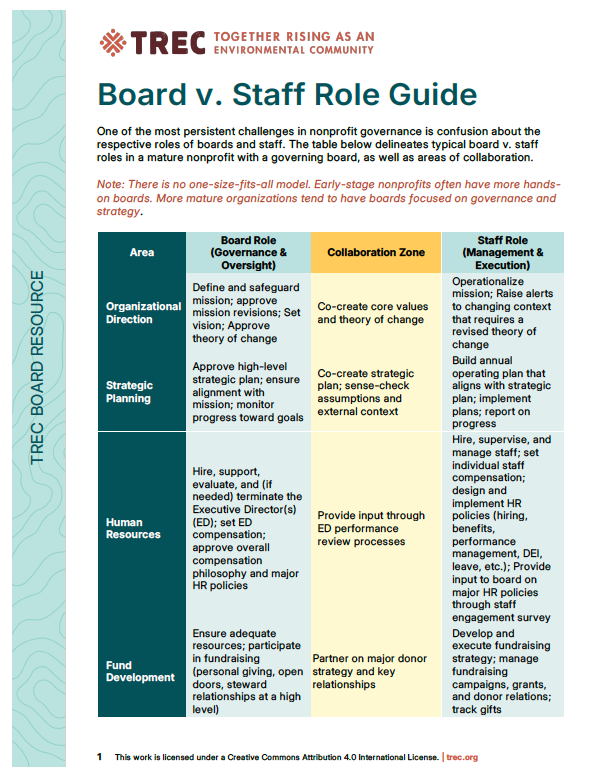
Here’s how roles are typically delineated across key areas. You’ll notice a gray area—a collaboration zone—where board and staff work together. This same zone can become a tension zone when there’s a confusion about roles. The key is clarity about roles in the moment. Who is advising? Who is deciding? Who is responsible for doing the work? If you can answer those three questions, you’re in good shape.
Final Thought: Clarity Is Kindness
Most board-staff tension isn’t about bad actors. It’s about unclear expectations. And in a time when nonprofits are navigating increasing complexity, polarization, and resource constraints, we can’t afford that confusion.
Clarity allows boards to focus on what they do best: governance, stewardship, and strategic insight. And it frees staff to lead, manage, and execute effectively.
Also, it makes board service a lot less confusing for that 24-year-old who just said yes because they didn’t know how to say no.
In service of clear lane lines,

Board v. Staff Role Guide
One of the most persistent challenges in nonprofit governance is confusion about the respective roles of boards and staff. The table below delineates typical board v. staff roles in a mature nonprofit with a governing board, as well as areas of collaboration.
Board v. ED Policy Approval Guide
This tool addresses a common challenge in board governance: the ambiguity between staff and board responsibilities in policy development. While ‘policy’ encompasses many areas—from strategic direction to operational guidelines—this tool helps clarify the distinct roles a governing board plays in policy approval and development. Note that role distribution varies by board type, with founding and working boards typically adopting more staff-like functions compared to traditional governing boards.
Visit Our Website
Through our website, we’re honored to offer more support to take the bold, grounded, actions that will empower your work in the months and years to come.
A streamlined job board and referral board for easier access to opportunities and connections. TREC’s newsletters will also be posted on our website blog, and most blog posts are open for your discussion!
Explore Our Learning Guides
Tailored to your needs, offering everything from foundational insights to complex solutions in our core offering areas.
Explore individual guides in TREC’s Core Offering Areas:

aparna rajagopal
Senior Consultant

What excites you most about your work?
I am most excited about meeting our client partner staff and board members in person; the vibe is so different and so much better!
What lights you up in your role—what feels like “YES, this is my thing”?
My current work stewarding TREC’s commitment to Indigenous partnerships and solidarity lights me up and is aligned with my personal commitment to repair, relationality, and reciprocity.
What’s the best piece of advice you’ve ever been given (or ignored)?
One piece of advice I was given was to ask myself “in service of what?” before taking any action (especially posting on social media!); it’s a great ego-check and ensures that what I do is aligned with the outcomes I’m hoping for.